
The challenge
What expires first, ships first.
In food and beverage the order things ship in is not decided by travel efficiency: it is decided by the date. What expires first ships first, even if it arrived later, and that single rule organizes the whole warehouse.
"A pallet shipped in the wrong order is not an inefficiency: it is product expiring on the customer's shelf."
Before & after
Without automation
- Storing by product rather than by lot and expiry, which forces a search for the right lot on every outbound.
- High rotation coexisting with seasonal references that occupy space for months.
- Traceability recorded at close of shift rather than at the moment of the movement.
- Receipts by full pallet and outbound requests sometimes by layer or by case.
- Product recalls that require knowing where each lot went, and quickly.
With STOKA
- Locate by lot and expiry, with the shipping criterion held by the system and not by the operator's memory.
- Separate the fast-moving area from the seasonal one, and size each by its own profile.
- Record the movement when it happens, which is the condition for traceability to be useful.
- Define where case-picking happens, if it happens, instead of letting it occur wherever there is room.
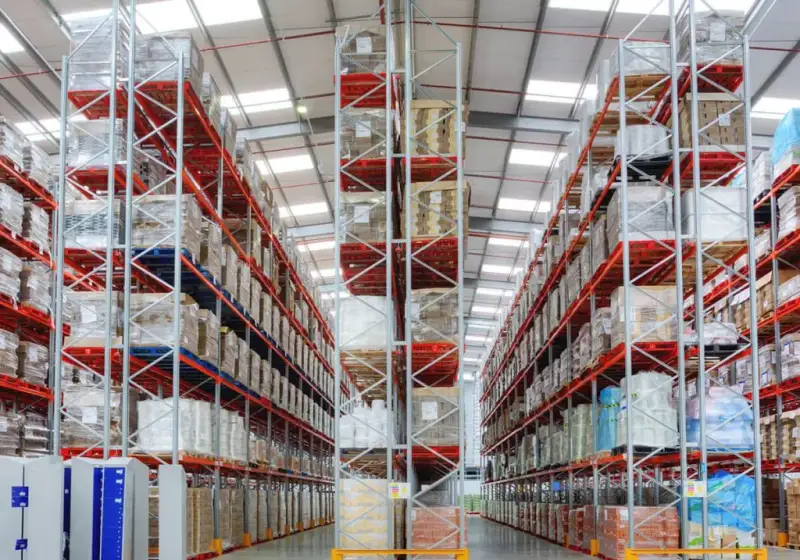
- Use height before discussing floor: a homogeneous load unit is the case where it works best.
Why automate
Key benefits
- Shipping by expiry, not by convenience.
Locate and dispatch so the lot closest to expiry is also the easiest to pick, instead of relying on someone remembering.
- Lot traceability you can rebuild.
Knowing which customer each lot went to and on what date, which is the only thing that allows a fast response when product has to be recalled.
- Full pallets, height put to use.
High rotation and a homogeneous load unit are the conditions where gaining positions without taking floor pays off most.
- Less handling per pallet shipped.
Routes and zones defined by rotation, so volume does not turn into movements that add nothing.
Automation context
Warehouse automation in food and beverage
In most warehouses the shipping order is decided by efficiency: pick what is closest and walk as little as possible. In food and beverage it is decided by the date. What expires first ships first, even if it arrived later, and that single rule reorganizes everything else: where each item is stored, how an order is picked, and what the system needs to know for the rule to hold without depending on anyone's memory.
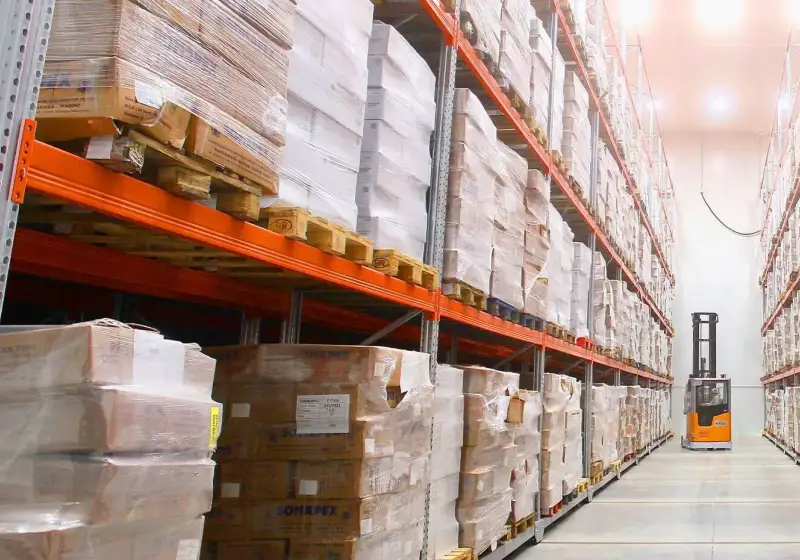
It is a volume warehouse. The load unit is usually the full pallet, rotation is high, and variety is lower than in other sectors. That makes it look, on the surface, like one of the simplest warehouses to design: few references, large quantities, predictable movement. The complexity is not in the volume but in the fact that every pallet carries a date, and that date takes priority over any travel consideration.
The requirement shaping the design is operational, and it is exactly that: expiry rules the shipping order and is not negotiable. It is not an efficiency preference or a best practice: a pallet shipped in the wrong order becomes product expiring on the customer's shelf, and that comes back as a complaint, a return, or a lost account. Everything else on this page follows from it — location by lot, shipping by date, and the ability to rebuild where each lot went. There is a regulatory layer above it, covering traceability and product recall, that is worth knowing and that we do not describe here: it is not verified in our data bank, and we would rather not cite it than cite it badly.
Keep reading
The process carrying the most weight is lot traceability, and its real test is a recall. A warehouse can run well every day and fail on the one day that matters, if it cannot say within hours which customers received a given lot. That capability is not improvised: it depends on every movement being recorded when it happens.
The typical mistake is storing by item instead of by lot and expiry. It is the intuitive approach — every reference in its place — and it forces someone, on every outbound, to look inside the location and decide which pallet should go. It works while volume is low and the person who knows is on shift. When volume rises, what breaks is not speed: it is the criterion, and lots start shipping that should not have.
One more thing that rarely gets designed and always gets improvised: what happens to product that comes back or gets rejected at receiving. In food it is not a marginal stream — a rejected load, a batch held pending release, a return from a customer all need somewhere to sit that is not the aisle, and a decision with a deadline. Leaving it undefined is how a volume warehouse slowly loses the positions it was counting on.
The second mistake is treating seasonality as if it were rotation. Some references move all year and others occupy space for months waiting for their season. Mixing them in the same zone makes the warehouse look full while the part that actually rotates competes for the best positions.
There is a tension worth resolving up front in almost every operation in this sector: receipts arrive as full pallets and shipments increasingly leave by layer or by case. Case-picking is the point where a volume warehouse turns into a picking warehouse, and if it has no defined place, it happens wherever there is room: next to the dock, in the aisle, on top of the pallet that was about to ship. Defining where it happens, with what unit, and who replenishes that area is a layout decision rather than an operating detail, and it determines whether volume turns into handling nobody asked for.
What improves at each step. Ordering means redefining location criteria so the position contains the answer, separating fast-moving from seasonal, setting where case-picking happens if it happens, and recording movements when they occur. Nothing is purchased and shipping stops depending on who is around. Equipping adds structure where height allows — the homogeneous load unit is the case where it pays off most — and management software that knows the lot in every position. Mechanizing appears when movement between zones starts weighing more than the operation. Automating is the step where the shipping rule stops being an instruction and becomes a property of the system.
When automation makes sense, specifically in this sector. This is one of the few cases where automation does not just speed up what was already being done: it removes an error that manual order cannot fully remove. A system that knows which lot is in each position executes shipping by expiry without anyone deciding it, on every order and every shift. In a warehouse where the rule holds ninety-something percent of the time, that remainder is what generates the complaint, and it is not solved with more training: it is solved by taking the decision away from the operator. It is worth looking at when volume already makes manual lot-by-lot control impractical, which tends to happen earlier than expected.
A note on refrigeration, because in this sector it always comes up: operating in temperature is a technical condition that changes equipment, energy cost, and what can reasonably be asked of a person inside the chamber. We do not develop it here because it is not specific to food — it applies to health products and chemicals too — and it has its own page. If your operation is chilled or frozen, that is the one you want.
Recommended equipment
Products for this sector
FAQ
Frequently asked questions about automation
What is the difference between shipping by arrival order and shipping by expiry?
Shipping by arrival assumes what came in first expires first, and in food that is not always true: a newer lot can have a shorter shelf life. What organizes the warehouse is the expiry date, not the receiving date, and a system that knows the lot in every position can hold that without anyone policing it.
What does it take to respond quickly to a recall?
Knowing where every lot went. That requires traceability recorded at the moment of the movement — receiving, putaway, picking, and dispatch — and not at the end of the shift. If the record happens afterward, rebuilding a lot's path becomes an archive job at the worst possible time.
Should product be stored by item or by lot?
By lot, when expiry rules. Storing by item is convenient for putaway and forces a search inside the location for which lot should go out. Storing by lot makes the position itself contain the answer.
And if the product needs refrigeration?
Operating in temperature changes the equipment, the energy cost, and what can reasonably be asked of a person inside a chamber. That is covered on the cold chain page, which is a technical condition and not a sector: it applies to food, but also to health products and chemicals.

Ready to automate?
Free consultation. Response within 24 business hours.
Our technical team analyzes your operation and proposes the most suitable solution with no commitment.