
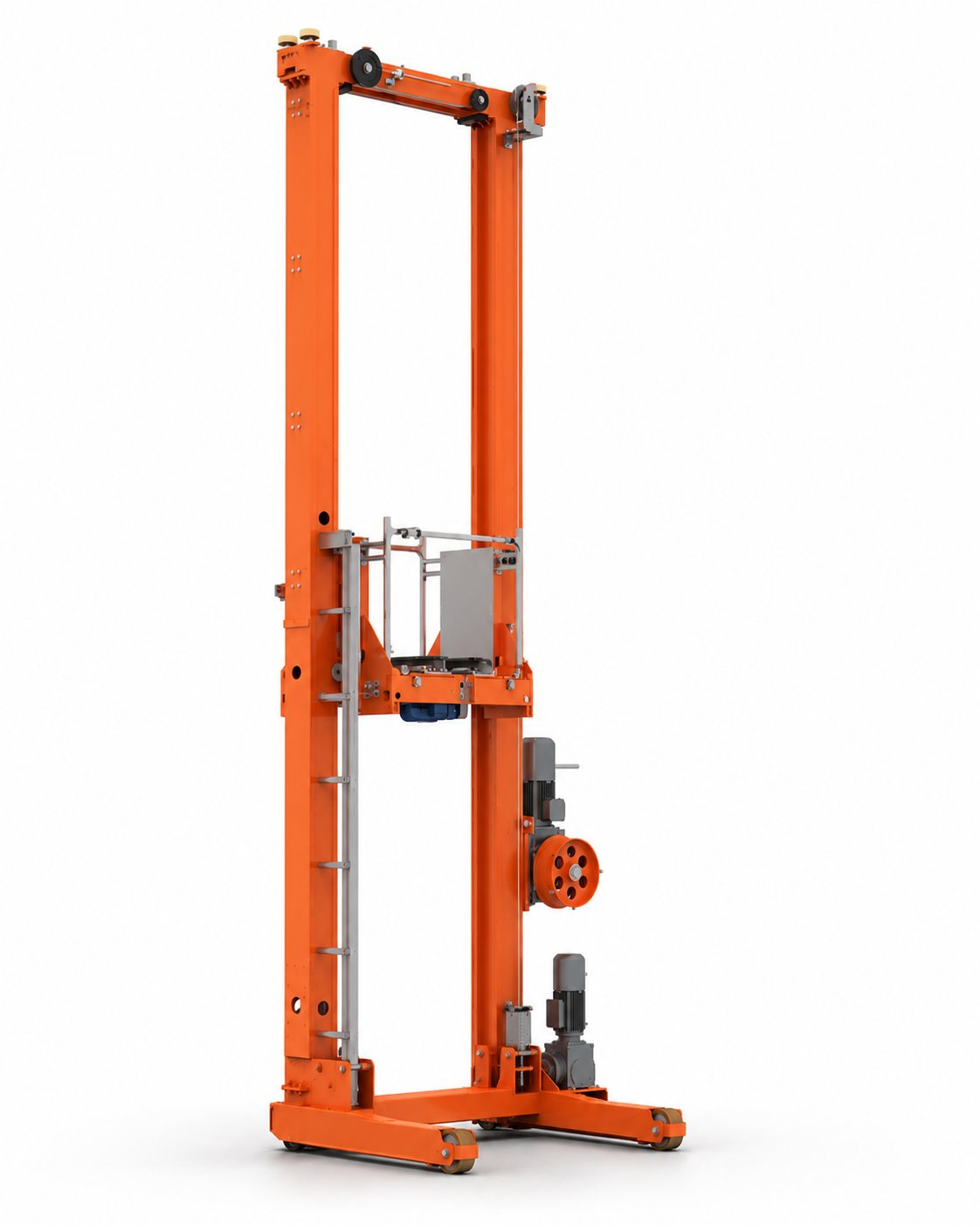
An ASRS (Automated Storage and Retrieval System) is the technology infrastructure that lets a warehouse or distribution center store and retrieve pallets, cases, and containers with no direct human involvement. Instead of operators driving forklifts through aisles of racking, an ASRS uses stacker cranes, shuttle robots, or shuttle carts that move automatically inside the rack, guided by WCS software that receives orders from the WMS. The payoff: higher storage density, faster operations, lower error rates, and reduced labor costs over the long term.
Core components of an ASRS system
A complete ASRS has four layers. The first is the storage layer: high-density racking engineered to bear the handling equipment and to maximize the available height of the warehouse. The second is the handling layer: the stacker cranes (cranes that travel within the aisle) or the shuttle robots (shuttles that operate inside the rack channel). The third is the transport layer: the chain, roller, or belt conveyors that connect the storage zone with the workstations. The fourth is the software layer: the WMS manages inventory and orders, while the WCS turns those orders into commands for the physical equipment.
Types of ASRS: stacker crane, shuttle, and mini-load
The unit-load stacker crane operates in aisles and handles full pallets of up to 1,500 kg at heights of up to 40 meters. It is the best fit for high-bay warehouses with high pallet-movement volumes. The mini-load stacker crane handles containers, cases, and totes in narrower aisles: ideal for intensive picking in e-commerce, pharmaceuticals, or manufacturing. The shuttle system (pallet shuttle or tote shuttle) uses autonomous robots that operate inside the rack channel, delivering maximum storage density with a smaller footprint. The VLM (Vertical Lift Module) is an alternative for workshops and spare-parts warehouses: it takes advantage of clear height without needing an aisle, with goods-to-person deliveries in under 15 seconds.
How a stacker crane works, step by step
The process starts in the ERP or sales system: when an outbound order is generated, the WMS receives and processes it. The WMS sends the retrieval mission to the WCS, which calculates the product's location, the availability of the nearest stacker crane, and the optimal route. The stacker crane travels to the correct position within the rack, extracts the pallet or container with its telescopic fork, and carries it to the outbound station. The full cycle-from order to delivery at the station-takes between 45 and 120 seconds, depending on storage height and depth. Every movement is logged in real time in the WMS, updating inventory with no manual intervention.
When it makes sense to install an ASRS in your warehouse
Suitability depends on actual flows, load units, space, safety and total cost. There is no universal minimum height or movement count that determines the right system. Compare process and layout improvements before specifying equipment.
First step: a free technical consultation
An ASRS is not just technology — it is a strategic decision that shapes a warehouse’s layout, processes and operating model for decades. That is why the decision should rest on measured data rather than assumptions: what load unit you have, how it moves today, what the building allows and what doing nothing costs. STOKA assesses your operation at no cost and tells you what can be done, in what order and what result to expect. If automating is not the right move, we say that too.
Frequently asked questions
Warehouse automation is the broad concept: it includes ASRS, AMR robots, conveyors, automated picking systems, and WMS/WCS software. The ASRS is the automated storage and retrieval portion, which can be the core of a fully automated warehouse or a targeted technology for a specific zone.
Timing depends on scope, manufacturing, transport, site preparation and integration. The proposal should separate these stages and define acceptance milestones before committing to a start date.
It depends on the design. If the warehouse has enough clear height and a level floor slab, the ASRS can be installed without major construction. Projects that require more height do call for building a new facility or expanding vertically. STOKA assesses technical feasibility on site before submitting a proposal.
A fault requires the shutdown and recovery procedure defined for the equipment. Access and maintenance require authorized personnel and control of hazardous energy. Do not assume an automated aisle can be operated with a forklift as an emergency alternative.