
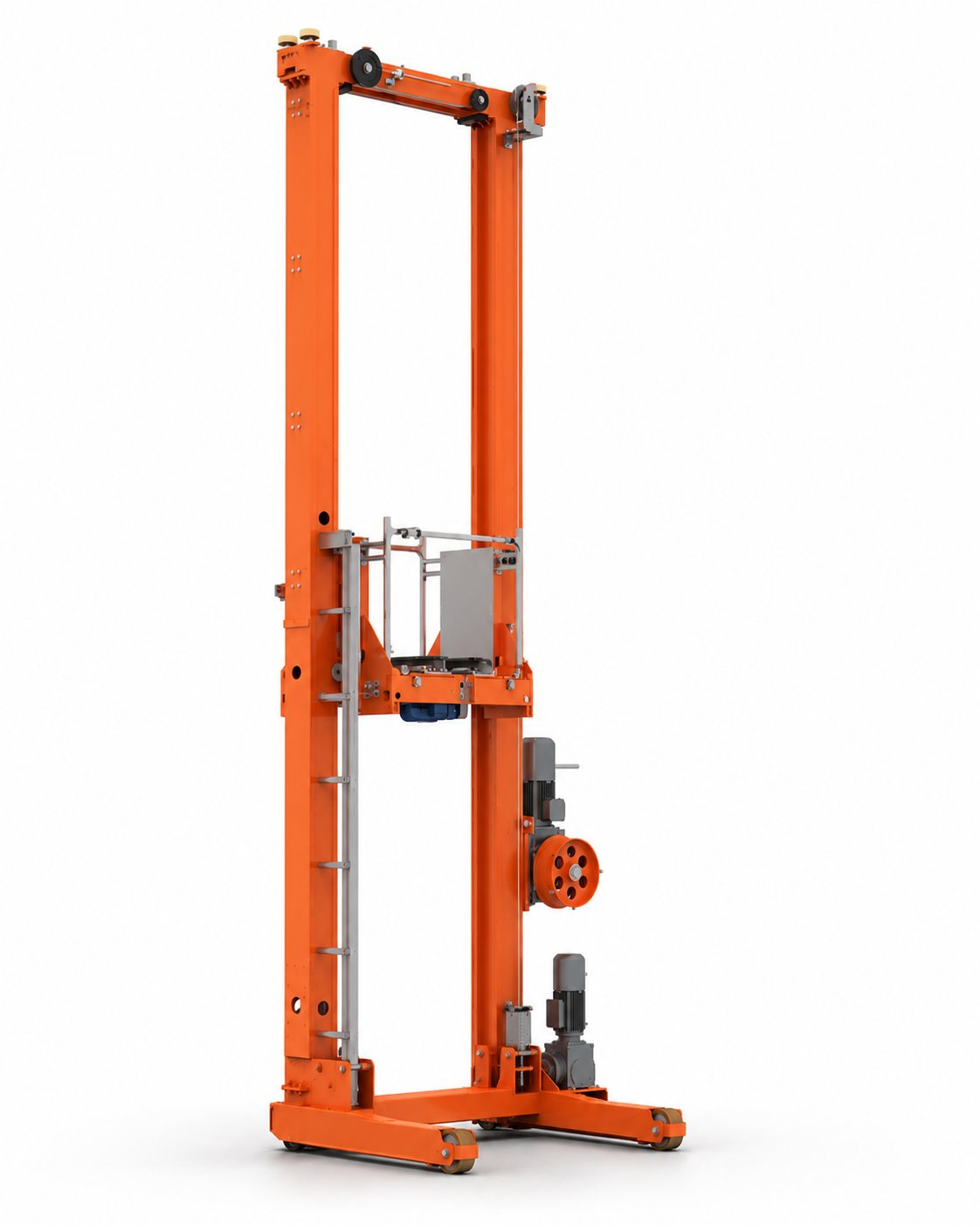
A stacker crane is an automated machine that travels along the aisle of a racking system, with no operator on board, and stores or retrieves a load from any position. It replaces the forklift trip with a guided movement, and it works at heights a driven truck can no longer reach.
What the parts of a stacker crane are, and what each one decides
This guide covers six things: the parts of the machine, the working cycle, the two types that exist, load capacity, the advantages and the drawbacks, and when the system fits a warehouse or distribution center.
The column, or mast, is the vertical structure the load rides up. Machines come with one mast or two: the double mast is used when the load is heavier or the storage height is greater. The mast sets how far up the machine reaches, within the 7 to 40 meter band of storage height this family of systems works in.
The cradle is the platform that travels up and down the mast carrying the load. The extractor sits on it, and it is the mechanism that enters the racking and takes or deposits the pallet or the case. Which extractor applies, whether telescopic forks, clamps or chains, is decided by the load unit you move, not the other way around.
The rails, one on the floor and a guide above, keep the machine aligned. That is why a stacker crane aisle is narrower than the one a driven truck needs: there is no room to be left for maneuvering.
And the controls. A stacker crane decides nothing on its own: it takes orders from a WCS, the software that tells each machine what to move and in what order, which in turn takes its own from the WMS, the system that knows where everything in the warehouse is.
How a stacker crane works, step by step
The cycle starts and ends in the software. There are five steps.
First, the order: the WMS takes a request, either to put away something that has arrived or to retrieve something that has to ship, and turns it into a specific instruction. Second, the assignment: the WCS decides which machine does it and in what sequence, and pairs movements so the machine does not travel back empty.
Third, the travel. The machine moves along the aisle and raises or lowers the cradle at the same time. Both movements are simultaneous, which is why cycle time is not the sum of the two distances.
Fourth, the extraction or the deposit: the extractor enters the racking and takes or leaves the load. Fifth, the confirmation: the movement goes back to the WMS and inventory is updated at the moment it happens, not at the end of the shift.
The point most often underestimated is the delivery point: the table, the conveyor or the station where the system leaves the load so it can continue on its way. That is where the automated warehouse connects to the rest of the operation.
The two types: pallet stacker crane and miniload for cases
What separates the two families is not the size of the warehouse: it is the load unit.
The pallet stacker crane, also called unit-load, moves the full pallet. It fits when what comes in and goes out is a whole pallet, when there are few SKUs with high volume each, and when there is height to take advantage of. It enforces FIFO, meaning the first pallet in is the first one out, without anyone having to remember, and it works in freezer storage down to −30 °C.
The stacker crane for cases, known as a miniload, moves cases, trays or plastic totes instead of pallets. It is the answer when there are thousands of small SKUs and orders are picked as individual units. It inverts the principle of the traditional warehouse: instead of the operator walking to the location, the system brings the case to a picking station.
The practical difference is which problem each one solves. If the bottleneck is space and what you move is pallets, the route is the pallet type; if the bottleneck is order picking and what you move is small units, the route is the miniload. It is common for both to live in the same building.
What the load capacity of a stacker crane depends on
Load capacity is not a universal number. It depends on three things, and all three are measured in your building.
The first is the equipment chosen. Each model has its own maximum load per movement, and that value comes from the equipment manufacturer data sheet, not from a general rule. A double-mast stacker crane takes more load than a single-mast one, and that difference is exactly why both exist.
The second is the racking, which is what carries the weight: the admissible load per location and per level is calculated by the structure supplier against the project design, and it is verified before assembly.
The third is the floor. The required flatness value and the load the slab admits are set by the manufacturer of the equipment chosen, and compliance is verified by a licensed professional with the corresponding measurement, during the site survey and before the design. Neither is a figure anyone can give over the phone: they are measured in your warehouse.
If any of the three values does not work out, the project does not collapse: it changes. The floor is corrected with whatever the professional who measured it prescribes, the configuration is adjusted, or a different architecture is chosen, and that work enters the plan with its cost and its schedule.
Advantages and drawbacks, stated plainly
A stacker crane is not the right answer for every warehouse. These are the two lists, and the second one matters as much as the first.
What it gains. It uses the volume sitting empty overhead: against conventional selective racking, densification can reach up to 3 times, and that is the ceiling STOKA sizes with. How much of that margin a given warehouse reaches comes out of the survey, with measured clear height, the load unit and real turnover. It also enforces rotation without anyone administering it, records every movement as it happens, and takes people out of the aisle, which is where incidents with lifting equipment occur.
What it costs. It is a capital investment, not an operating expense, and the building has to cooperate, which is verified before designing. It puts a ceiling on flexibility, because changing the layout of an automated warehouse is considerably more expensive than moving racking. And it depends on the software: a poorly resolved integration shows every day.
The drawback that ruins the most projects is a different one. If the operation is not in order beforehand, automating does not put it in order: it speeds it up. An automated system executes the process it is given, so with locations badly assigned the result is the same disorder, faster and harder to correct.
When a stacker crane is worth it, and what gets measured first
It is worth it when the building has run out of usable volume and there is height to take advantage of; when the operation moves full pallets with few high-volume SKUs; or when it works in cold storage, where every hour a person spends inside is expensive and punishing. It is not worth it when daily volume is low or very irregular, when the assortment changes constantly, or when the real problem is order rather than capacity: there, reorganizing locations and rotation solves more and costs less.
Three figures are taken before that decision. Real clear height, which is the height up to the lowest thing in the way, beams, pipes and sprinklers included, and not the one on the drawing; if the building falls below the 7 to 40 meter band, what applies is a different family of systems, such as vertical lift modules or high-density racking.
The load unit, measured on the worst case that circulates through your warehouse rather than on the standard pallet: the film that sticks out, the case that tips, the broken pallet. And the movement profile: how many SKUs you have, how many movements per hour you need to sustain at peak, and what share of your outbound is full pallet versus individual units.
Commissioning an automated system takes 3 to 4 months from the purchase order, and covers manufacturing, shipping, assembly and start-up. Before that come the site survey and the design, and how long they take depends on how well organized the operation data is.
The first step is measuring your operation, not asking for a quote
The decision does not start with the price: it starts with knowing whether the system is right for what you move. STOKA assesses your operation with your data and shows you the capacity your building has today. If automating is not the right call yet, we say so and explain what it would take.
Frequently asked questions
The stacker crane travels along the aisle and lifts the load to the location; the shuttle robot works inside the racking channel and gains density in depth. Cold storage differs too: the pallet stacker crane goes down to −30 °C and the shuttle robot to −25 °C.
Yes, and that is the most common case. What gets verified first is the real clear height up to the lowest obstruction, the condition of the floor, and the load unit in circulation. That measurement is taken in the building during the site survey, and you get the result before deciding.
It depends on the equipment chosen: maximum load per movement is declared by that equipment manufacturer data sheet. The racking, which carries the weight, and the floor, whose admissible load a licensed professional verifies before assembly, both have to support it as well.
A miniload is a stacker crane for cases, trays or plastic totes instead of pallets. It works in narrower aisles and brings the case to a picking station, where the operator picks the order without walking. It is chosen by the load unit.