
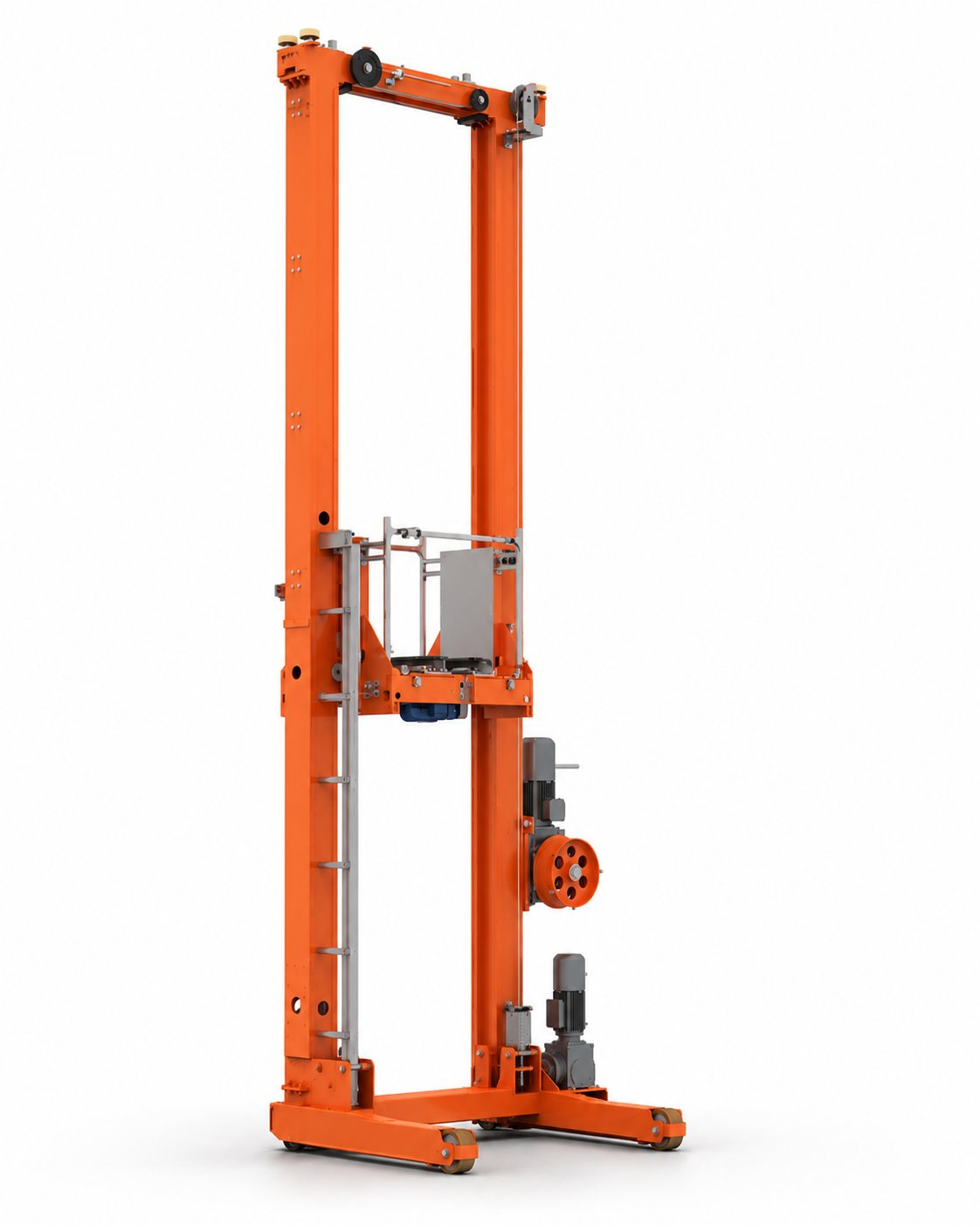
By far the most common question people ask before requesting a quote is whether their warehouse "works" at all. It almost always works for something: what changes with the building’s condition is not whether something can be done, but what should be done. This page sorts four scenarios by clear height and floor condition, and says what makes sense in each. None of them ends in nothing being available, because that is not true.
What does a warehouse need in order to be automated?
Three things, all verified in the survey: enough clear height for the system, a floor meeting the flatness and load the system demands, and a standard load unit. The specific floor and load values are set by the equipment manufacturer for the chosen system, and they are measured on site before quoting.
If you have less than 7 metres of clear height
Automated pallet systems work from 7 to 40 metres, so below 7 metres of clear height a full pallet system does not fit. That does not end the conversation. Properly sized conventional racking already uses a good part of the volume currently sitting above the load, and it is an investment of a different order. Vertical tower storage also belongs here, using available height without needing an aisle, as does work on the process itself: removing stock that does not move, reassigning locations by turnover and standardising the load unit. In this scenario most of what you gain costs no equipment.
If you are inside the range of the automated systems
From 7 metres upwards automated pallet systems come into play, and they work up to 40 metres. Here the decision becomes economic rather than technical: the system is possible, so what settles it is whether the volume and the labour cost it replaces justify the investment. It is also the point where doing the process work first pays off most, because if rearranging solves the problem, the capacity the height unlocks stays available for future growth instead of being spent absorbing present disorder. How much that height unlocks in your case is what the survey tells you.
How to calculate the value of the space you free
Value space using your own rent or property opportunity cost. Released space can support growth or reorganization; it only saves rent when an actual payment obligation is reduced.
The floor: something to measure, not to guess
Height enables; the floor conditions. Two properties matter: flatness, because the higher you stack the less unevenness is tolerated — the error amplifies with height — and load capacity in kilos per square metre, which changes when weight concentrates on rack baseplates instead of spreading out. The exact values are set by the equipment manufacturer for each system and verified by measuring the floor on site. A floor out of tolerance is not a no: it is a levelling line item in the budget, or a different system with lower demands. What you cannot do is assume it complies and find out during commissioning.
What applies in any of the cases
There is a case that does not depend on height: the warehouse whose problem is order rather than volume. It applies within any of the previous ones and it is the most frequent. Three levers cost no equipment and usually relieve the operation: removing stock that does not move, which in almost every warehouse holds the best positions; reassigning locations by turnover, so what ships most sits near dispatch; and standardising the load unit, which is in any case a prerequisite for any future automation. If after those three the warehouse fits, nothing needed buying.
When there is no standard load unit
One condition cuts across every case and is not solved by height: the load has to be describable as a unit with dimensions and weight inside a known range. A pallet, a case, a container. That is what lets any equipment pick it, move it and place it without deciding case by case. When the warehouse holds coils, profiles of varying length and unpackaged items, there is no standard unit to define, and there the preliminary work is not on the building but on the packaging. Sometimes that work pays for itself, because it tidies up the whole operation; when it does not, the right answer is a partial solution covering the portion of stock that is homogeneous, and leaving the rest as it is.
What defines the scenario is measured in one visit
Clear height at the lowest point, floor flatness and load capacity, current positions and turnover profile. With those four figures in hand the scenario is settled, and the conversation stops being about which system to buy and becomes about what should actually be done — which fairly often does not include buying anything at all. STOKA makes that visit at no cost and hands over the measured figures, whether or not they end up justifying a system.
Frequently asked questions
We do not work with a minimum height: clear height defines which systems fit and how much density you can gain, not whether the warehouse qualifies. Automated pallet systems work from 7 to 40 metres, so below 7 metres of clear height what you should be looking at is vertical tower storage, properly sized conventional racking, or work on the process itself.
It depends on the system, and the value is set by the equipment manufacturer. The general rule is that the higher you stack, the less unevenness is tolerated, because the error amplifies with height. It is verified by measuring the floor on site, before quoting.
That also depends on the system and is set by the manufacturer. What changes compared with a conventional warehouse is that the weight stops spreading out and concentrates on the rack baseplates. It is a survey verification, not an estimate.
That is not a no. It can be handled with a levelling line item in the budget, or by choosing a system with lower demands. What you cannot do is assume it meets the spec: it gets measured before quoting, because finding out afterwards is expensive.