
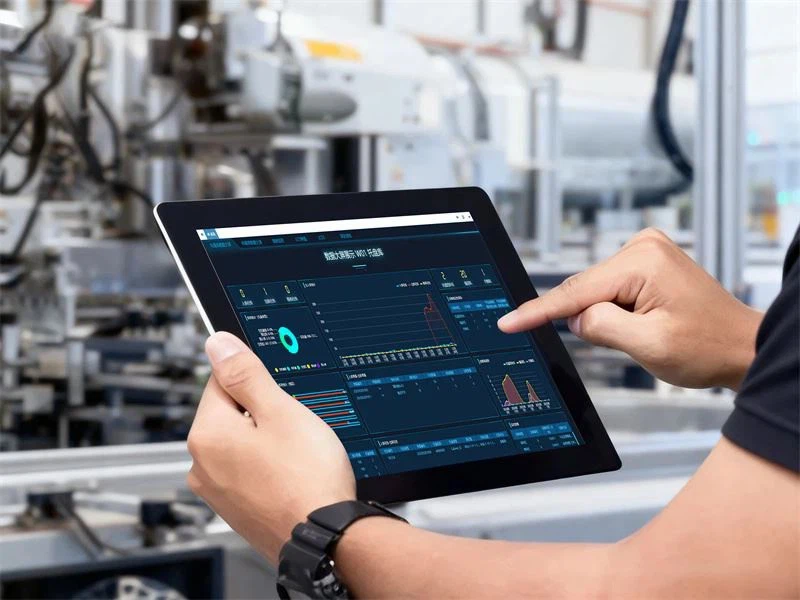
Smart logistics, Logistics 4.0, Warehouse 4.0, smart warehouse: these are terms that appear more and more, but are rarely explained clearly. Is it just marketing or is there something concrete behind it? In this article we clarify what smart logistics really is, how it differs from traditional logistics, which technologies make it possible and what concrete results it generates. If your company is evaluating modernizing its operation, understanding these concepts is the first step to making good decisions.
What smart logistics is
Smart logistics is the management of the supply chain and warehouse operations based on data, automation and connectivity to make decisions in real time. Unlike traditional logistics —reactive and dependent on human judgment—, smart logistics anticipates, optimizes and self-corrects. A smart warehouse does not just store: it measures, learns and continuously adjusts its operation to maximize efficiency, density and accuracy.
What Logistics 4.0 is
Logistics 4.0 is the application of Industry 4.0 technologies —Internet of Things (IoT), automation, artificial intelligence and data analytics— to logistics. In practice, it means physical equipment (stacker cranes, robots, conveyors) communicate with the management software and with each other, forming a connected and autonomous operation. Logistics 4.0 is the infrastructure that makes smart logistics possible: without automated equipment and data, there is no intelligence to apply.
The technologies that make smart logistics possible
Four technological layers support a smart warehouse. First, automatic storage systems (ASRS): stacker cranes, shuttles and VLM that handle goods without manual intervention. Second, logistics robotics: AGV and AMR that transport products autonomously. Third, management software: the WMS (warehouse management) and WCS (equipment control) that orchestrate everything. Fourth, real-time data: sensors and connectivity that feed decisions. The integration of these four layers is what distinguishes an automated warehouse from a truly smart one.
Traditional logistics vs. smart logistics
Inventory accuracy is measured by comparing records with physical stock. Results depend on receiving and dispatch records, location rules, training and controls; software or robots do not guarantee an accuracy percentage.
What results smart logistics generates
The benefits are measurable: reduced cost per order, higher picking productivity, fewer errors and returns, better space utilization and full inventory traceability. For regulated sectors such as pharma, food or export, traceability is not just efficiency but regulatory compliance. And in a context of rising labor costs and difficulty finding staff, smart logistics turns automation into a competitive advantage, not a luxury.
Smart logistics is no longer the future: it is the present
Smart logistics and Logistics 4.0 are no longer abstract concepts: they are concrete operations that combine automation, software and data to do more with less. A smart warehouse is not just a warehouse with robots, but an operation that measures, learns and continuously optimizes itself. For companies facing cost pressure, lack of space or labor shortage, taking the step toward smart logistics is increasingly less an option and more a competitive necessity. At STOKA we design that transformation tailored to each operation.
Frequently asked questions
Logistics 4.0 is the technological infrastructure (automation, IoT, AI, data); smart logistics is the result of applying it: an operation that decides in real time with data. One makes the other possible. In practice, both terms are often used interchangeably.
A smart warehouse is a facility that integrates automation, robotics and management software to operate with minimal human intervention, continuously measuring and optimizing its operation. It combines ASRS systems, robots, real-time data and WMS/WCS.
No. There are scalable solutions that allow SMEs to start with one module —a VLM, a picking system— and grow. In Argentina, tax benefits also make it easier for SMEs to access these technologies.