
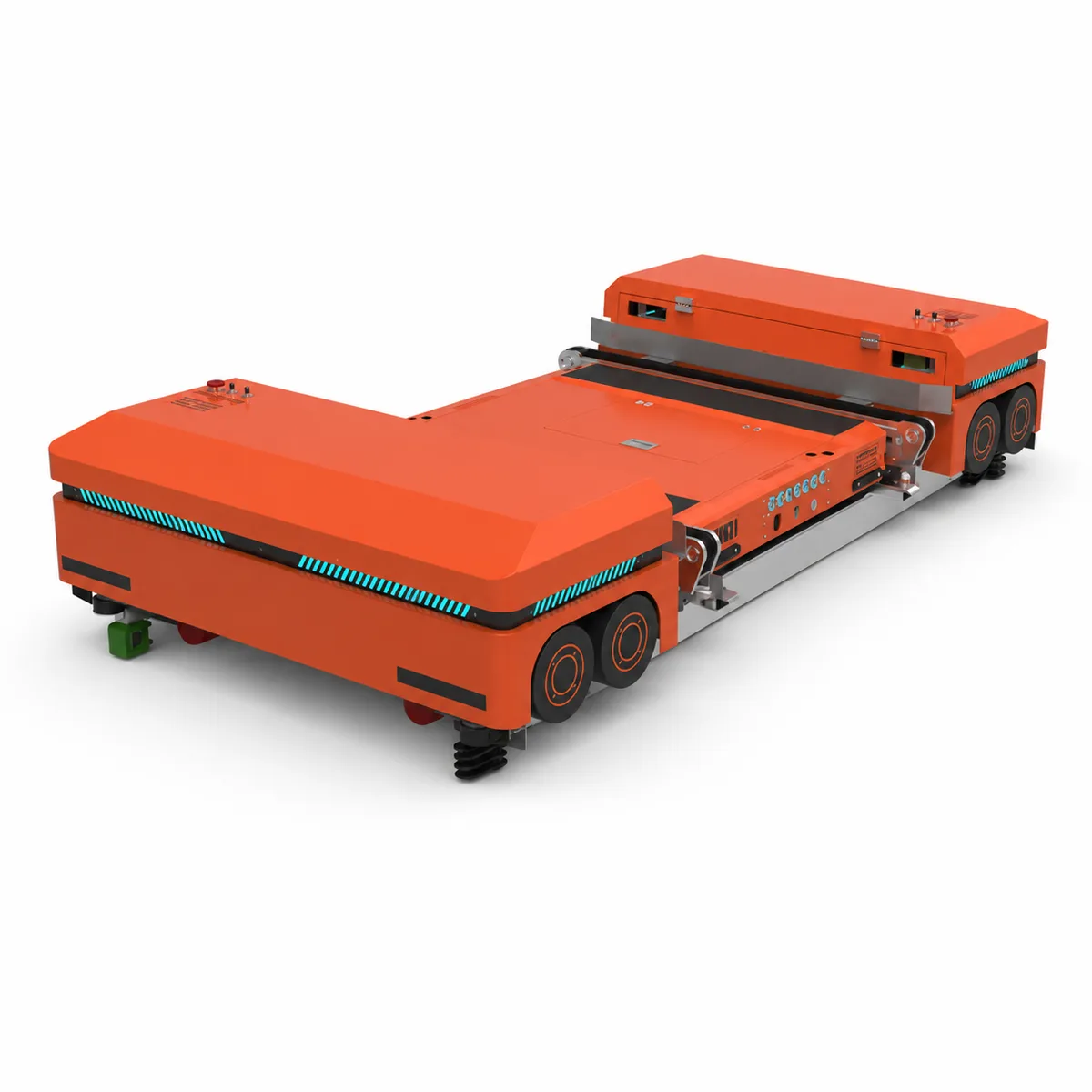
AGVs and AMRs are two types of mobile robots used for internal transport in warehouses and industrial facilities. Both replace the work of a forklift or an operator pushing a cart, but they go about it in very different ways. Choosing between an AGV and an AMR is more than a technical call: it has real consequences for operational flexibility, installation costs, maintenance and your ability to scale. This guide breaks down the concrete differences so you can pick the right option for your operation in Argentina.
How each one navigates: the fundamental difference
An AGV (Automated Guided Vehicle) follows predefined routes that are physically marked on the floor: magnetic tape, QR codes or inductive wires. The route is fixed, so if the warehouse layout changes, the guidance system has to be physically reconfigured. Its strength is high repeatability and precision on constant routes, which makes it ideal for production lines where the flow is always the same. An AMR (Autonomous Mobile Robot) builds a map of the warehouse and navigates freely using SLAM (Simultaneous Localization And Mapping). It detects obstacles in real time with laser sensors and 3D cameras, and recalculates its route within milliseconds. It needs no floor markings and no physical changes to the layout.
Flexibility vs. repeatability: which matters more for you
If your warehouse has fixed, predictable flows — the same route from the production line to storage, day in and day out — the AGV is the more robust option with lower maintenance costs. If your operation changes frequently (seasonal layouts, a variable product mix, picking zones that rotate), the AMR comes out ahead because its map updates without any physical intervention. An operator can add restricted areas, variable speeds and preferred routes directly from software. AMRs also adapt better to environments where people and equipment move around in unplanned ways.
Implementation and maintenance costs
An AGV is generally cheaper to purchase than an equivalent AMR. However, the AGV carries additional installation costs: the physical guidance (magnetic tape, floor QR codes, etc.) has an upfront cost and requires periodic maintenance. AGVs also call for more detailed layout engineering before installation. AMRs have a higher purchase price but a lower installation cost: the initial mapping takes 1 to 2 days and requires no construction work. For operations with stable layouts lasting 5 years or more, the AGV can come out cheaper on total cost of ownership. For operations with frequent changes or spaces shared with people, the AMR delivers a lower TCO.
When to combine AGVs and AMRs in the same operation
Many mid-size and large facilities in Argentina use both types of robots in different zones. AGVs handle the routes from the production line to storage: fixed, repetitive flows with heavy loads. AMRs work the picking and dispatch zones: variable flows, coexistence with people, and a need to adapt. The same WCS can manage both fleets seamlessly, assigning missions dynamically so each robot gets the job best suited to its capabilities. STOKA designs the optimal mixed-fleet architecture for every installation.
The right choice depends on your real layout and flows
There is no universal winner between AGV and AMR. The AGV is the best option for fixed, predictable flows; the AMR is the better fit for dynamic environments shared with people. In many warehouses, combining the two maximizes ROI. The STOKA team maps the flows of your current operation and recommends the optimal combination during a free initial consultation.
Frequently asked questions
The timeline is built from stages that can be dated: mapping the warehouse, integration with the WCS, operator training and acceptance testing. An AMR fleet needs no civil works or physical modifications, so construction is not the driver; integration and training are. The proposal separates those stages and fixes the milestones before committing to a start date.
Yes. Modern AMRs are certified to operate in environments with people: they carry sensors that detect obstacles and brake before reaching them, and the detection and braking distances are stated in each unit’s datasheet. In high-traffic zones, the WCS sets up virtual traffic lights to prevent congestion.
It depends on throughput, the average distance of each trip and the load/unload speed. STOKA simulates the optimal fleet using data from your operation. As a reference, a 2,000 m² warehouse handling 200 missions per hour can run on 8 to 12 medium-capacity AMRs.
Yes. AMRs integrate via REST API with any WMS or ERP. The WCS acts as middleware between the management system and the robots, making the integration transparent for the client's system.