
Order picking follows two philosophies, and the difference fits in one sentence: either the operator goes to the goods, or the goods come to the operator. The first is called person to goods and it is how the vast majority of warehouses work. The second is called goods to person: the goods travel inside an automated system to a fixed station where somebody picks them without walking. What changes between the two is not only technology. Routes change, the floor space you occupy changes, the ergonomics of the workstation change and so does the investment profile.
Two philosophies, one simple difference
In person to goods, meaning the operator goes to the goods, a person travels the warehouse with a cart or a forklift, stops at each location and takes what the order asks for. It is the classic arrangement, and it works.
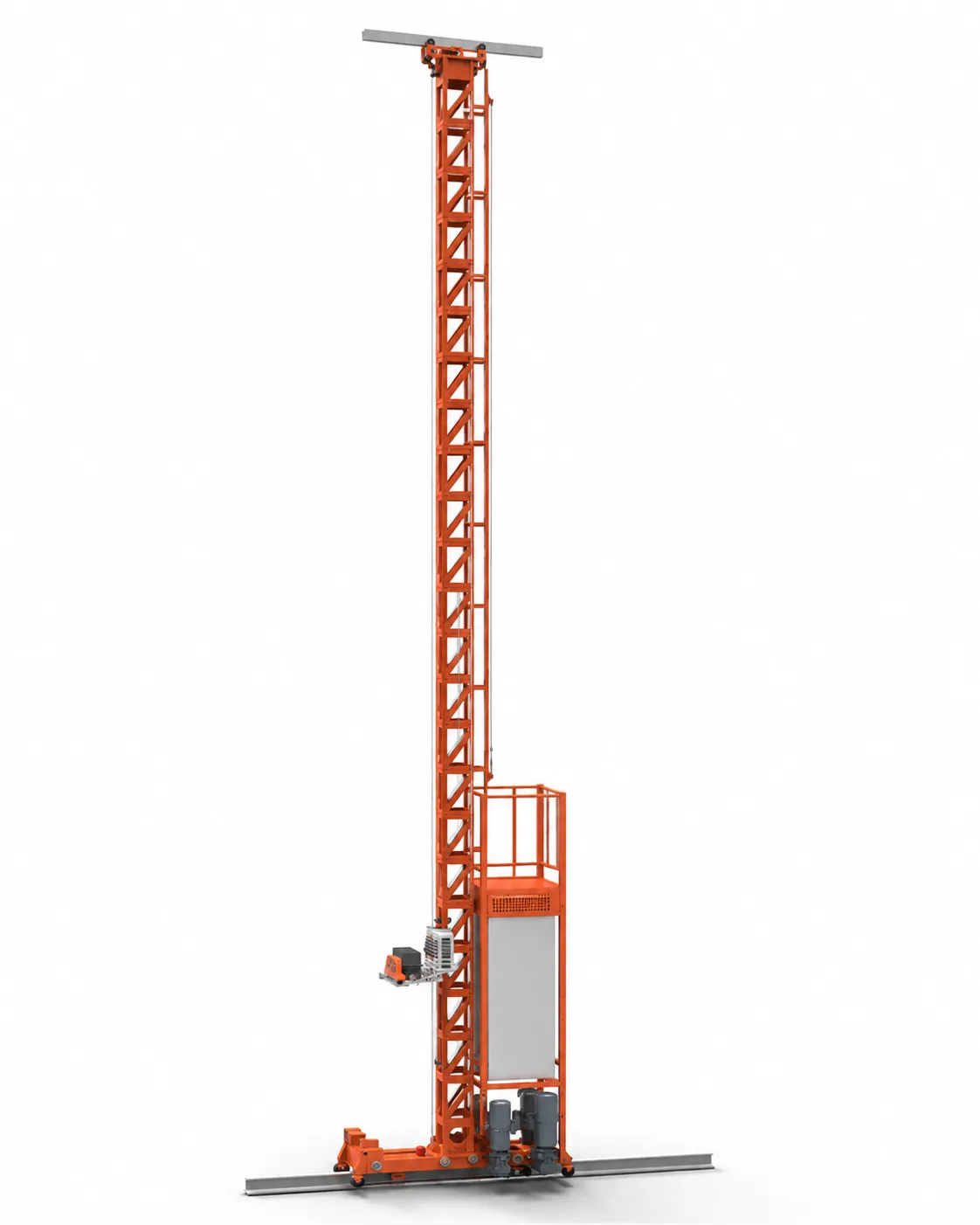
In goods to person, meaning the goods go to the operator, nobody travels. An automated storage and retrieval system, or AS/RS, brings the case or the pallet to a picking station, the person takes what is needed and the system returns the container to its location. It can be built with stacker cranes, with shuttles moving inside the racking itself, or with autonomous mobile robots, or AMRs, that lift whole racks and carry them to the station.
The practical difference is where time is spent. In the first arrangement, most of the operator time is travel. In the second, travel is done by the machine and the person only does the part that requires hands and judgement.
What changes in travel
In a conventional warehouse, the largest share of picking time is not grabbing the goods: it is walking between one location and the next. The larger the building and the more scattered the items, the higher that share.
In goods to person that share disappears from human work. Travel is not eliminated: the system does it, in parallel and without pauses, while the operator picks the previous line.
That changes the unit of measurement on the floor. In person to goods you think in metres walked per line; in goods to person you think in lines per station per hour, and the bottleneck moves from the legs of the operator to the ability of the system to deliver containers at the station.
Growth behaves differently too. Adding items to a conventional warehouse lengthens everybody routes. In an automated system, adding items lengthens the system queue, which is offset with more stations or more cycles, without anyone walking further.
What changes in floor space
Conventional storage is limited by the reach of the forklift and by the aisle width it needs to manoeuvre. Automated storage is not: it works at heights of 7 to 40 metres and with far narrower aisles, because the machine is guided on rails or moves inside the racking itself.
The effect on the floor is significant. Under the criteria STOKA uses to size projects, densifying vertically allows up to 3 times the capacity in the same surface and frees up to 66% of the floor, depending on the available clear height and on the configuration of the system.
Value space using your own rent or property opportunity cost. Released space can support growth or reorganization; it only saves rent when an actual payment obligation is reduced.
What changes in ergonomics and risk
A goods to person station is a fixed place, with the goods at hand height, its own lighting and no vehicle traffic around it. The operator does not lift loads from the floor or reach above shoulder height, and does not share an aisle with a forklift.
That changes two concrete things. The first is exposure: a large share of serious warehouse incidents happens in the interaction between people and vehicles, and in an automated system that interaction is confined to maintenance areas, which are interlocked and access controlled.
The second is who can do the job. A station with no physical strain and no driving licence requirement widens the pool of people who can fill it and shortens training.
Person to goods also has room to improve without automating anything: placing fast moving items at hand height, organising traffic directions and separating pedestrian from vehicle routes solves a good part of the ergonomic problem with minor works.
What changes in investment and flexibility
Value recovered time using your actual operating costs and measurements of the tasks that change. Distinguish time available for other work, reduced overtime and expenses that can actually be avoided.
Payback is calculated using the full investment and your operation’s net savings. Separate genuine expense reductions from capacity available for growth; freeing space or time does not automatically save cash.
The flip side is flexibility. A team of people can be reassigned in a day. An automated system is sized for an operating range, and moving far outside that range is expensive.
When does goods to person make sense?
When three conditions come together, and not before.
The first is sustained volume of loose unit or case lines, every day of the year, not in three seasonal peaks. An automated system is paid for by use.
The second is scarce or expensive floor space. If you cannot grow sideways because there are no metres available in the area or because a metre costs what it costs, growing upwards stops being a preference and becomes the only way out.
The third is a process that is already in order. If the layout is untidy, stock does not match the system and orders arrive at any hour, an automated system fixes nothing: it automates the disorder and makes it faster and more expensive to correct.
Inventory accuracy is measured by comparing records with physical stock. Results depend on receiving and dispatch records, location rules, training and controls; software or robots do not guarantee an accuracy percentage.
When person to goods is still the right answer
In more cases than is usually admitted. If your operation has few items, orders with many lines and full pallet dispatch, the operator does not walk much and there is no dead time to recover: there is no problem to solve.
If volume is strongly seasonal and the building runs at half capacity the rest of the year, installed capacity sits idle and payback stretches beyond any reasonable horizon.
If the mix keeps changing, with new formats and different load units every season, the flexibility of people is worth more than the speed of a machine.
And if the process still has room to improve, with fast moving items far from the loading dock, inventory that does not reconcile or badly distributed shipping windows, that room is cheaper and faster to capture than any investment. The process comes first; robotics only enters if volume still calls for it once the process is in order.
The question is not which one is better
Goods to person and person to goods do not compete in the abstract: they solve different profiles. If your orders are few and large, if volume is seasonal, or if the process still has disorder to fix, the operator walking to the goods remains the right and cheaper answer. If you have sustained volume of small lines, scarce or expensive floor space and a process already in order, bringing the goods to the operator changes the equation of travel, space and ergonomics at the same time. The way to know which case you are in is not reading: it is measuring your own operation.
Frequently asked questions
It means the goods travel to the operator. Instead of a person walking the warehouse, an automated storage and retrieval system brings the case or the pallet to a fixed picking station, the person takes what is needed and the system returns the container to its location. Travel stops being human work and becomes machine work, running in parallel with picking.
No. It is more efficient when there is sustained volume of loose unit or case lines and many scattered items, because travel time then dominates the shift. With few items, orders of many lines and full pallet dispatch, the operator barely walks and the automated system has no dead time to recover: the investment finds nothing to pay itself back with.
It depends above all on the clear height of the building. Under the criteria STOKA uses to size projects, densification reaches up to 3 times the capacity in the same surface and up to 66% of the floor freed, depending on the available clear height and on the configuration of the system.
The work changes in shape more than in headcount. Jobs stop being forklift routes and become fixed stations, with no lifting from the floor and no shared aisles with vehicles. That shortens training and widens who can fill the role. New tasks also appear: system supervision, exception handling and first level maintenance.
Payback is calculated using the full investment and your operation’s net savings. Separate genuine expense reductions from capacity available for growth; freeing space or time does not automatically save cash.